
Key takeaways
- The Central Kalahari Game Reserve is the second-largest game reserve in the world and the largest protected area in Southern Africa, larger than Switzerland.
- December to April is the green season, when fresh grass in fossil valleys like Deception Valley draws springbok, gemsbok and the predators that hunt them.
- Access is deliberately hard: 4 to 6 hours by self-equipped 4×4 from Maun, or a 45 to 90 minute light-aircraft charter onto remote airstrips.
- The reserve was proclaimed in 1961 as a sanctuary for the San people and wildlife, and the San connection to this land runs back tens of thousands of years.
- A combined mobile camping and lodge itinerary pairs the Kalahari's raw remoteness with permanent-camp comfort, and suits groups weighing budget against structure.
The Central Kalahari Game Reserve is a vast expanse of fossil riverbeds, pans and dune grassland in the heart of Botswana, larger than Switzerland, and it rewards travelers who want true isolation over convenience. You come here for black-maned lions on empty valley floors, for star fields unbroken by any town, and for a silence most safari destinations cannot offer. This guide covers the reserve's scale, its desert-adapted wildlife, the green-season spectacle at Deception Valley, the San heritage woven into the land, and the precise logistics of getting a group in and out.
Savanna Safaris runs guided itineraries across Botswana, and the Kalahari is one of the few places where the choice between mobile camping and a permanent lodge genuinely changes the trip. We will return to that decision throughout, because it drives the budget, the comfort and the daily rhythm of a Kalahari safari more than any other factor.
Scale and Solitude: Africa's Second-Largest Game Reserve
The Central Kalahari Game Reserve ranks as the second-largest game reserve in the world and the largest protected area in Southern Africa. That is a land mass larger than Switzerland, set aside with almost no permanent infrastructure. There are no towns inside the boundary, no tarred roads, and across huge sections no mobile signal at all.
The solitude here is real and verifiable. A single pan can run for kilometers with one vehicle on it. Lodges inside the reserve are small and far apart, and the mobile campsites are unfenced clearings with a long-drop toilet and a bucket shower. This scale creates a specific kind of planning problem for groups:
- Distances between sightings are long. You may drive two hours between productive areas, so game drives are full-day commitments with packed lunches.
- Fuel and water are self-carried. Vehicles enter with everything they need. There is no resupply inside the reserve.
- Vehicle redundancy matters for groups. A single breakdown deep in the sand is serious, so experienced operators run recovery gear and, for larger parties, a support vehicle.
The Kalahari is the opposite proposition to the water-based north: dry, vast, and quiet, where a single pan can stretch empty to the horizon.
Desert-Adapted Wildlife: Lions, Oryx and Meerkats
The Kalahari is not empty. Its animals have evolved to survive heat, distance from water and sparse grazing, and the result is a cast you will not find in the lush delta. The headline species are desert specialists.
Black-Maned Kalahari Lions
The reserve's lions are famous for their dark manes and their lean, long-legged build. They range over enormous territories because prey is thinly spread, and in the green season they concentrate around the fossil valleys where grazers gather. Daytime sightings improve markedly when the pans green up, as prides follow the herds onto open ground. Piper Pan and Deception Valley are the classic lion areas.
Gemsbok (Oryx)
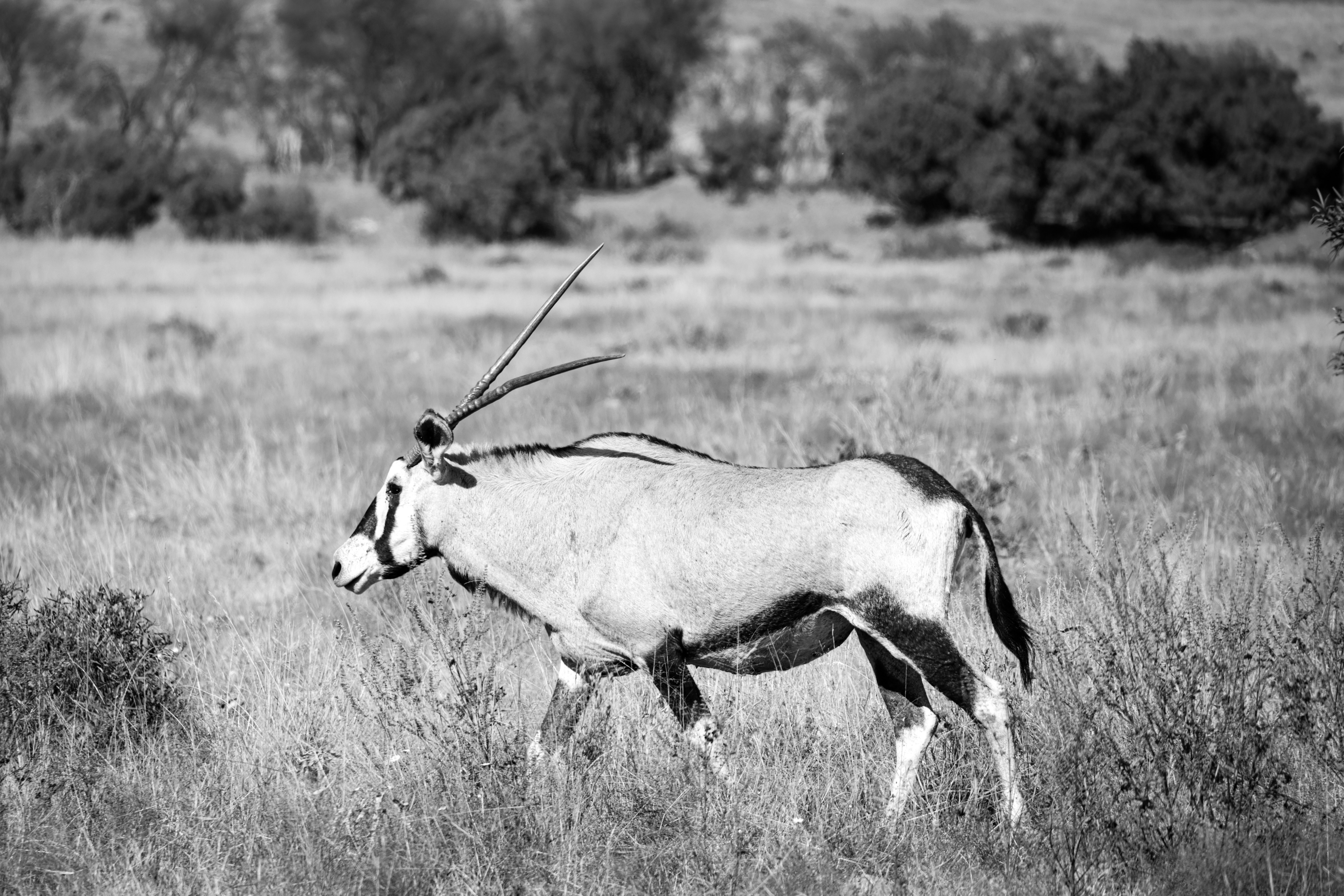
The gemsbok is the emblem of the Kalahari. These large antelope, with their straight rapier horns and striking black-and-white facial masks, survive with almost no standing water, drawing moisture from grass, melons and roots. Herds build through the green season and are a staple sighting on the valley floors.
Meerkats, Brown Hyena and Cheetah
Smaller and stranger residents fill out the roll call:
- Meerkats live in sentinel colonies across the dune grassland, and habituated groups in some areas tolerate quiet visitors on foot.
- Brown hyena, one of Africa's most elusive carnivores, are resident here and were the subject of long-term research at Deception Valley.
- Cheetah hunt the open country, and the Kalahari's sparse cover gives strong odds of a sighting during the herbivore concentrations of the wet months.
- Springbok, wildebeest and hartebeest form the large grazing herds that draw the predators in.
The Kalahari trades the full Big Five for desert specialists and space. Travelers set on classic big cats, elephant and buffalo volume will find the north of Botswana a better fit, with the Kalahari as a contrast leg rather than the whole trip.
The Green-Season Spectacle at Deception Valley
Deception Valley is an ancient fossil river that cuts across the northern Kalahari, and it is the reserve's most reliable wildlife theatre. For most of the year it reads as a pale ribbon of dry grass. Then the rains arrive.
From roughly December to April, summer storms push fresh green grass across the valley floor and the neighbouring fossil systems of Sunday Pan and Piper Pan. Grazers respond within days. Springbok, gemsbok, wildebeest and hartebeest pour onto the new growth in herds that can number in the thousands, and the predators, lions and cheetah chief among them, follow the food. This inversion is the heart of a Kalahari trip: the wettest, hottest months deliver the best game viewing, which is the reverse of most African safari destinations.
The valley earned its name from the mirage effect shimmering over its pans, which once deceived early travelers into seeing water that was not there. It also carries a research legacy, as it was the base for the brown hyena and lion studies recounted in the book Cry of the Kalahari.
Green-season planning carries real trade-offs:
- Tracks turn to black-cotton mud after heavy storms, which can delay drives and occasionally strand vehicles.
- Storms are usually short. Afternoon downpours clear quickly, and the light after rain is exceptional for photography.
- Game is concentrated, not guaranteed. Herds move with the grass, so a good guide's knowledge of which pan greened first is decisive.
Cultural Heritage of the San People
The Kalahari is the ancestral homeland of the San, among the oldest continuous human cultures on Earth, with roots in this landscape stretching back tens of thousands of years. Their tracking knowledge, plant lore and water-finding skill are the original survival technology of this desert, and they shape how the best guides read the land today.
The reserve itself is bound up in San history. The Central Kalahari Game Reserve was proclaimed in 1961 as a sanctuary intended for the Bushmen to live in, as documented by the indigenous-rights organisation Survival International. The decades since have included a contested relationship between San communities and the state over residence and water access inside the reserve, a reality worth understanding before you visit rather than romanticising.
For visitors, the cultural dimension is best experienced through guided walks with San trackers, offered by some operators on the reserve's fringes and nearby communities. These walks focus on practical bushcraft: identifying medicinal plants, reading spoor, and understanding how people lived here without permanent water. Approach them as genuine knowledge exchange, not performance.
Fossil Valleys, Pans and the Lay of the Land
Understanding the reserve's geography helps a group plan where to base and how to move. The Kalahari is a semi-arid savanna over deep sand, stitched with ancient drainage lines that no longer flow. Picture open grassland and scrub rather than the towering dunes of the Sahara.
The key features are:
- Deception Valley in the north, the prime green-season game area and the usual first base for fly-in groups.
- Sunday Pan and Piper Pan, further fossil systems that hold herds and predators when the grass is up.
- Passarge Valley and the central sand ridges, remote and lightly visited, for travelers who want to go even deeper.
- Deception, Leopard and Kori pans, open clearings that serve as wildlife focal points.
Because these features sit far apart, groups typically split a Kalahari stay across two bases or combine the reserve with a second region entirely. The reserve pairs naturally with the Makgadikgadi salt pans to its north for a dryland circuit that avoids backtracking.
Climate and the Reality of Desert Extremes
The Kalahari is a land of temperature extremes, and underestimating them is the most common planning mistake. Summer days bake. Winter nights freeze.
Summer highs in the wider Kalahari reach up to 46C (115F), while winter nights can fall to -12C (10F), according to World Atlas. Frost is common on winter mornings from June to August. The daily swing is dramatic in any season, so a January afternoon can scorch while the dawn drive that follows still needs a fleece.
Practical consequences for a group:
- Green season (December to April) means heat, afternoon storms and the best wildlife. Pack for sweat and sun, and expect humidity after rain.
- Dry season (May to October) brings mild days and genuinely cold nights. Open-vehicle dawn drives in July demand hats, gloves and blankets, which camps usually provide.
- Layering is non-negotiable year-round. Pack a warm fleece and a windproof layer even for a January trip, since dawn drives stay cold whatever the afternoon does.
Best Time to Visit the Central Kalahari
The short answer: come in the green season, December to April, for wildlife, and the dry season, May to October, for comfort and easier travel. The two experiences are almost different destinations.
Green season (December to April) is the wildlife peak. Fresh grass concentrates herds and predators on the fossil valleys, lion and cheetah viewing is at its best, and newborn antelope add to the drama. January is the wettest month and the heart of the spectacle. The costs are heat, insects and occasionally difficult tracks.
Dry season (May to October) scatters the game across a wider area and reduces overall numbers in the valleys, but driving is straightforward, skies are clear, and the cold nights are bearable with the right kit. This window suits first-time safari-goers who prioritise smooth logistics over maximum game density.
If you are weighing the Kalahari against a water-first trip, note that the Okavango Delta peaks on the opposite calendar, with its flood arriving in the dry months. A combined itinerary therefore often chases two different seasons, which shapes when you travel.
How to Get There: Charter Flights Versus the 4×4 Route
Access is the defining logistical decision for a Kalahari group, and there are two realistic routes in.
Light-Aircraft Charter
Most lodge guests fly. Charters from Maun reach the reserve's bush airstrips in roughly 45 to 90 minutes, landing near Deception Valley or at camp-specific strips such as Tau Pan. Flying saves a hard day of driving each way and delivers you rested.
The critical constraint is luggage. Light aircraft enforce strict soft-bag weight limits, commonly around 15 to 20 kg per person including hand luggage, with no hard-shell suitcases. Brief every group member on this before departure, because a single oversized rigid case can bump a seat or force a costly second flight. Pack soft duffels, and leave hard cases in secure storage in Maun.
Self-Drive or Chauffeured 4×4
The road route runs 4 to 6 hours from Maun over sand tracks, entering through Matswere Gate for the northern valleys. This option demands a fully equipped 4×4, GPS navigation, recovery gear and genuine desert-driving experience, since there is no signal and no quick rescue. For groups, a chauffeured 4×4 with an experienced guide-driver removes that risk and turns the transfer into part of the safari.
These access choices connect directly to the style of trip. Fly-in groups almost always base at lodges, while overland groups more often camp, a split our overview of mobile versus lodge safaris in Botswana unpacks in detail.
Mobile Camping, Lodges and Hybrid Group Itineraries
The Kalahari is one of Botswana's clearest cases for mixing accommodation styles, and a hybrid itinerary often serves a group best. The three configurations groups ask for most are group camping plus lodge nights, group luxury camping, and combined camping and lodge safaris across a single route. Here is how the two core styles compare inside the reserve.
| Parameter | Mobile camping | Permanent lodge |
|---|---|---|
| Setting | Private unfenced site, erected for your group | Fixed small camp, built infrastructure |
| Power | Solar or generator, limited hours, charge gear on drives | More reliable, still often generator-based and scheduled |
| Access | Suits overland 4×4 routing | Usually fly-in by charter |
| Group size fit | Flexible, scales to your party | Fixed room count, book early |
| Cost | Lower per night, shared camp crew | Higher, all-inclusive comfort |
| Experience | Raw, close to the ground, full immersion | Comfortable, structured, more amenities |
Two operational realities deserve emphasis for any group:
- Power is limited in the bush. Remote camps run on solar or generators with set charging windows. Bring a power bank and charge cameras during drives. Do not expect hairdryers or reliable all-night power.
- Mobile camping is a full-service setup. A crew pitches your tents, runs the kitchen and manages the bucket showers before you arrive. The trade is comfort for intimacy and a lower price.
A common hybrid for a group of six to ten pairs two or three nights of mobile camping deep in the fossil valleys, where immersion matters most, with lodge nights at either end for recovery, laundry and a proper bed. This structure keeps the daily budget down while giving every traveler a soft landing before and after the camping leg.
Group Logistics, Pricing and Planning Essentials
Pricing in the Kalahari tracks the access method and the accommodation style more than the time on the ground. Fly-in lodge safaris sit at the premium end because charter costs and all-inclusive camps add up. Overland mobile camping is markedly cheaper per night, and a hybrid lands in between. Kalahari trips generally run toward the higher end of the camping spectrum once charter transfers are added, so build those flights into the budget from the start.
Concrete planning recommendations for a group:
- Book charters as a block. Light-aircraft seats and small camps fill early, especially in the green season. A group of eight needs coordinated flights and rooms secured months ahead.
- Confirm the luggage policy in writing. Weight and bag-type rules vary by aircraft. Circulate them to every traveler so nobody arrives with a hard case.
- Plan for no connectivity. Share an emergency contact protocol, since large parts of the reserve have no signal. Tell families back home to expect silence.
- Match the season to the group's priority. Wildlife-focused groups should accept green-season heat; comfort-focused groups should take the dry-season cold nights.
- Build in a non-Kalahari leg for first-timers. Pairing the reserve with the delta or Chobe gives a group variety and a softer introduction before the remoteness.
Groups wanting a gentler first safari before committing to the deep Kalahari can open with a northern leg in Chobe or Moremi, then move south into the desert once everyone has found their rhythm on game drives.
Why the Kalahari Suits Travelers Seeking True Remoteness
The Central Kalahari rewards a specific temperament. It is for travelers who count a single lion on an empty pan as richer than a crowded sighting elsewhere, and who treat the drive, the silence and the night sky as part of the experience. The reserve's scale and its deliberate lack of infrastructure are the whole appeal.
That said, the Kalahari is not a sensible first and only safari for everyone. Big-game density is lower than the north, access is harder, and the heat or cold is real. Travelers who want guaranteed elephant and buffalo volume should pair it with Chobe or Moremi. Those chasing the desert's particular magic, the black-maned lion, the gemsbok against a storm sky, the San tracker reading spoor in the sand, will find it unmatched.
The most effective next step is to decide your access and camping style, then lock dates against the season you want. Tell Savanna Safaris your group size, your green-season-versus-dry-season preference and your budget ceiling, and we will build a hybrid route that puts your tents where the game is and your lodge nights where you need the rest.
Frequently asked questions
How big is the Central Kalahari Game Reserve?
It is the second-largest game reserve in the world and the largest protected area in Southern Africa, a wilderness larger than Switzerland set aside with almost no infrastructure.
What is the best time to visit the Central Kalahari?
The green season from December to April delivers the strongest wildlife concentrations, as rain brings fresh grass to the fossil valleys. Game viewing peaks around January despite the heat.
How do you get to the Central Kalahari Game Reserve?
Most travelers fly a 45 to 90 minute light-aircraft charter from Maun onto a bush airstrip, or self-drive a fully equipped 4×4 for 4 to 6 hours over unmarked sand tracks.
Can you see lions in the Central Kalahari?
Yes. The reserve is known for black-maned Kalahari lions, which concentrate around fossil riverbeds such as Deception Valley and Piper Pan during the green season.
Is the Central Kalahari good for a group safari?
It works well for small groups, especially as a hybrid mobile camping and lodge itinerary. Light-aircraft luggage limits and remote-camp power constraints make group planning essential.


